Hanna Kay: Equilibrium 2
- JOMO
- Jan 11
- 6 min read
Updated: Jan 17
Inviting Viewers into a New Dialogue

Introduction: Jo Moulton. Jan 2026
I recently revisited the remarkable artist Hanna Kay in her galvanized iron shed/studio on her five acre plot on the banks of the Pages River in the Upper Hunter Valley, NSW. Hanna brings with her the knowledge and wisdom that comes from an ‘artistic and intellectual trajectory’ that has taken her across continents, civilizations, cultures, languages, war and metropolises – Tel Aviv, Vienna, New York and Sydney, to this pocket of land. This country has pulled her into a biblical dialogue with Nature in all its complexity – "its darkness and light, floods and droughts, cycles and seasons, its moods, its destruction, decay and its remarkable regeneration." Her studies since arriving in Australia include a BA in Semiotics and Philosophy, University of Sydney and a PhD in Fine Arts and Philosophy at the SCA, University of Sydney. There is a prodigious mind at work in both her art and writings fueled by what she has dubbed as her "intra-action" with Nature.
Hanna is an example of the virtuoso level of artistic talent, often hidden away in the far reaches of rural Australia, where the artist is connected directly with Nature. In order to survive, these artists rely heavily on the professionalism of regional galleries to exhibit their work, to build their audiences and tap into the fragile Australian art market. At seventy nine years of age, Hanna is working at a frenetic pace and deep into her 'equilibrium 2' meditation.


Works in progress for the upcoming exhibition Equilibrium 2
For many years she has obsessively observed weeds "frost bitten or drought thirsty...supporting a plethora of insects and living creatures." Her preoccupation with the weeds that invade her garden grounds her. She is simultaneously deadly serious and humorous. She once observed the lawn mowing experience as"when weeds and grass cave in and an army of panicked creatures run for their lives. They hop,jump,creep,crawl and fly to find shelter in the uncut grass. At times I see myself as a greedy landlord, evicting the tenants, or worse still, a demolish-er of homes". (Notes from the Shed, Hanna Kay 2007)
On a philosophical level, there is the curious issue of the 'fencing' and 'un-fencing' of weeds (and dingoes) depending on which side of the fence you are." At the domestic level there are burning issues...the death of the dog, grieving by the remaining dog, the new dog settling in and the irritating strain of physical aging. There is no question of compromising her century old tempera technique, precise brushstrokes, layer upon layer of semi-opaque paint combined with the more contemporary splattering of paint. On the global level, her 'equilibrium' meditation is preoccupied with the wider issues.."our treatment of the environment and its people, be it refugees on the other side of the world, or migrants, the tension between human transiency and the resilience of the natural environment".


These are confronting themes, tensions that Hanna explores through what she describes as 'intra-action' with her natural surroundings. It is her way of understanding place and it triggers a full spectrum of cultural,intellectual and artistic responses. Her exquisitely light and dark paintings of weeds, full of complexity and abstraction, are a testament to her ability to express her internal dialogue through Nature.

A booklet of weeds - work for her up-coming exhibition (and a generous gift to me).
As the relationship between artist and Nature evolves this 'intra-action' can open a diverse range of memories and reactions - historical, technical, intellectual, cultural and emotional.
It is that 'creative space' between Art and Nature that is shared by visual artists, film/media makers, landscape artists and architects. It is hard to think of any artist, at least in rural Australia, who has drilled into this space with such intellectual and emotional intensity.

It was a treat for me to visit Hanna Kay and although it was a short visit we re-connected and I am delighted that her creative force still goes from strength to strength.I recommend a full read of Hanna's essay 'equilibrium 2' and I shall add a link to an earlier video produced by her partner, Leslie Wand, on her earlier 'equilibrium' exhibition.

'Equilibrium 2' Essay by Hanna Kay
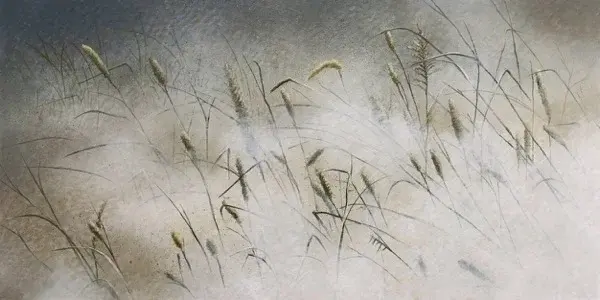
This body of work is inspired by my immediate natural surroundings in the small rural village in which I live. My daily walks are framed by fields of feral grasses and weeds stretching from one side where the trees edge the river bank, to the other side, reaching the slopes of the ranges. In some seasons, the dew on the tall weeping stalks will glitter in the rising sun, while the setting evening sun will catch the tips of motionless grasses turning the fields bronze. At other times the grasses are short, either frost bitten or drought thirsty. But whether towering or low, the grasses always support a plethora of living creatures. At best we call this multiplicity of flora cattle feed, but usually they are simply annoying weeds.
At first, in my fenced property, weeds were not welcomed. I had attempted to control their invasion only to be kept at bay by the realization of the arbitrary nature of the definition ’weed’. I intended to replace unwanted ‘ugly’ vegetation with an assortment of what I had considered beautiful and desirable plants. Definitions mark the ‘bad’ from the ‘good’, the ‘useful’ from the ‘obnoxious’. Nature itself does not have any such intrinsic attributes. Every thought we formulate, every value we attribute, every adjective we articulate in regard to the natural environment is our projection, our cultural constructions.
A fence marks the boundaries of my land. Unlike most fences it does not keep animals in or out of the property, and neither does it control weeds. Across the country, unfenced sprawling fields of ‘weeds’ are a rarity. Even the vast arid plains of central Australia are fenced and controlled. There is also a long fence to keep dingoes in or out (depending on which side of the fence you are). And there are also patrolled invisible fences marking the boundaries between different colour, race and beliefs of people who inhabit the land.

The term "shibboleth", the title I gave one of the series of paintings in the exhibition, is taken from my native language Hebrew, and it means ‘ear of grain’. For me, in addition to personal memories of singing odes to the harvest of the land, and of glorious images of golden fields of wheat swaying in the breeze, it evokes the Biblical myth of a massacre of members of one tribe by their brothers - the legend tells that after their defeat by the Gileadites, the Ephramites tried to escape across the Jordan River. Stationed next to the banks of the river, the Gileadites would ask each person attempting to cross to say the word ‘shibboleth’. The Ephraimites, who were unable to enunciate ‘sh’ sounds, would say ‘sibboleth’, and thus revealing their identity. The Gileadites slaughtered 42,000 members of the Ephraim tribe.
Historically, the word was used as a pronunciation test to identify the ‘other’. These days the word has a wide range of common meanings and is used differently in several disciplines, including semiotics, linguistic and philosophy. According to the Merriam-Webster dictionary ‘shibboleth’ is: 1) an old idea, opinion, or saying that is commonly believed and repeated but that may be seen as old-fashioned or untrue; 2) a word or way of speaking or behaving which shows that a person belongs to a particular group. This body of work intends to draw attention to the arbitrariness of definitions, in particular when it comes to our treatment of the environment and its people, be it refugees on the other side of the world, or migrants and neighbours and their ‘otherness’ that disturbs our fenced equilibrium.

Experiences of the peculiarity of the ‘other’ does not always have to do with pain and intrusions. Nature, that the landscape presents, is just another way of meeting that which is different to us. Whether inspiring or threatening the working of nature's forces is inscribed on rocks, trees, deserts, and mountains. These aspects of the natural environment are portrayed in the artworks, and evoke nature’s own cycles as marked by the seasons and Aeolian processes. The presence of natural forces that may at any moment act, for better or worse, upon any place (fenced or un-fenced) is evidenced in each of the artworks. The depicted natural phenomena intend to evoke an unforgiving Nature, which is oblivious to us and our social and cultural constructions. The paintings are personal, remembered encounters in the landscape and an attempt to highlight the tension between human transiency and the resilience of the natural environment.
![Habitat [lost] IV 2019, Oil and tempera on linen 66 x 66 cm](https://static.wixstatic.com/media/a385c7_d42e32287f5e40b7a8738aa44888c8c5~mv2.jpg/v1/fill/w_650,h_651,al_c,q_85,enc_avif,quality_auto/a385c7_d42e32287f5e40b7a8738aa44888c8c5~mv2.jpg)
Hanna Kay Jan 2026
Planned Exhibitions:
Singleton Art and Cultural Centre - May 16 - August 9 2026
Tamworth Regional Gallery - December 11 2027 - February 6th 2028
New England Regional Gallery, Armidale - beginning of 2027 (final dates TBC)
Lake Macquarie - Yapang - Regional Gallery, 2028 (final dates TBC)
Publication:'Notes from the Shed' by Hanna Kay (published by Macmillan 2006)
YouTube Video produced by Hanna's partner Leslie Wand
Hanna's website: https://www.hannakay.com/
Former biophiliarts blogs on Hanna Kay


Comments