A Case for NO MINE:Through the Eyes of East Gippsland Artists and Artisans.

Updated: Sep 14
Re: Glenaladale Fingerboards Critical Mineral Sands Mining Project East Gippsland:
To: Planning Impact Assessment Unit, Department of Environment, Planning and Resources
Response to Draft Environmental Effects Statement Scoping Requirements
by Jo Moulton: Creative Industry and Cultural Heritage Advocate/Publisher

Native Orchid Celeana (Flying Duck Orchid). Photo by Michael Prideaux
Introduction
My name is Jo Moulton. I grew up in Bairnsdale, associated closely with Lindenow farming families and the Italian community that farmed the Mitchell River Valley in the 1950s and 60s. I returned to the area to live 25 years ago. I am a former Cultural Industries Advisor, Business Victoria, former E.G. economic development consultant, Founder of the East Gippsland Food and Wine Industry Group and Co-founder, Director of the Feast on East Festival. I also have a Design Practice, Studio JOMO. As a Fine Arts/Art History and Education graduate (University of Melbourne) with experience in major museums and art galleries, I have documented, contextualised and exhibited artists and creative practitioners of East Gippsland for ten years in an ‘Art Meets Nature’ gallery/blog @ biophiliarts.com
biophilia: bʌɪə(ʊ)ˈfɪlɪə noun: a genetically determined affinity of human beings with the natural world. Cambridge Dictionary
"Creative practitioners (artists and artisans; designers, architects, chefs, winemakers), like scientists, play a significant role in monitoring, nurturing and interpreting the beauty, complexity and fragility of the natural world'. The late Edward O Wilson, Harvard biologist, naturalist, ecologist, entomologist who developed the field of socio-biology.
“With ‘biophilia’ comes a restless curiosity, an urge to investigate and discover the elusive places where we meet Nature, where she plays on our senses with colours and forms, perfumes and smells.” Sir Richard Attenborough, Natural Historian, Conservationist, Ethicist.

Nest by Gordon Bain 'Bird Water Man,' Walpa 2018
'Aesthetics' and The Law
'The term "aesthetic" in conservation and environmental law refers to the legal and philosophical protection of nature based on its visual, sensory, and scenic beauty rather than strictly utilitarian or ecological values. It stands to reason, therefore, that, apart from natural, Indigenous or historic heritage value, a place may also have ‘other’ heritage value — social and aesthetic attributes.
In the past campaigns built on the beauty of wilderness, aesthetic arguments have frequently been overshadowed in actual legal proceedings by hard scientific data and economic cost-benefit analyses, which are viewed as more objective. Courts, however, have now recognized aesthetic injury—such as the diminished capacity to enjoy a natural environment—as a valid basis for plaintiffs to establish legal standing in environmental disputes'.
According to Tasmanian lawyer and Professor Benjamin Richardson environmental law has aesthetic dimensions.
Aesthetic values have shaped the making of environmental law, and in turn such law governs many of our nature-based sensory experiences. Aesthetics is also integral to understanding the very fabric of environmental law, in its institutions, procedures, and discourses.” Richardson brings new insights into the importance of aesthetic issues in a variety of domains of environmental governance around the world, from climate change to biodiversity conservation. He argues 'for aesthetics, and relatedly the arts, to be taken more seriously in the practice of environmental law so as to improve our emotional and ethical capacities to address the upheavals of the Anthropocene." Richardson (2019) The Art of Environmental Law: Governing with Aesthetics
UNESCO integrates aesthetics into international law primarily by recognizing aesthetic value and natural beauty as legal criteria for global heritage protection. The Convention concerning the Protection of the World Cultural and Natural Heritage 1972 Article 2 (abbreviated) defines "natural heritage" as consisting of physical and biological formations or groups of such formations,which are of value from the aesthetic or scientific point of view;...natural sites of value from the point of view of science, conservation or natural beauty.

Artist: Nicholas Chevalier Dargo Valley 1865 Chromolithograph on paper Gippsland Art Gallery Collection
Summary of Objections to Gippsland Critical Minerals Mining Proposal and Draft Environmental Effects Statement Scoping Requirements
I have listened to and monitored Gippsland Critical Minerals (GCM) proposal and the counter evidence by a range of expert and experienced consultants - engineers, geologists, economists etc. I conclude that the GCM proposal, like the former Kalbar proposal, simply does NOT stack up. It over-promises on a range of issues and the proposed new hierarchical framework for assessment waters down a range of community concerns - by creating a hierarchical framework, a top down set of priorities that appears to favour the expediting of government mining policy to implement their Victorian Critical Mineral Sands Mining map, without genuine social license.
Strong community concerns include impact on our environment and rich biodiversity, our community health and well-being, horticultural, agricultural and tourism industry livelihoods, impact on our roads, contamination and excessive extraction of water from the Mitchell River and the downstream impact on the Gippsland Lakes and Ramsar sites, impact on First Nations cultural sites and their connected community well-being.
Will the State Government pay for ‘a bottomless pit’ (excuse the pun) of long-term destructive environmental, cultural and heritage impacts, loss of community and workers health, well-being and jobs and the legal challenges that emerge when GCM promises turn out to be lacking substance? Who will take responsibility for driving families, settlers, creative practitioners, businesses and tourists from the region?
Others will protest additional concerns, such as, unsubstantiated claims by GCM relating to their business case; investment expectations, costings on construction, process, engineering technology, transportation, local employment estimates and global market competitiveness. Expert analysts will object to carcinogenic health risks for workers and local communities, the Australia-wide mining industry track-record of failure to fulfill rehabilitation promises, claims and costings re transportation to suitable port facilities that will impact on local and regional roads. There is also concern throughout the community about water consumption and contamination of the Mitchell River, Gippsland Lakes and Ramsar sites, all interconnected, and the potential for permanent sub-surface contamination of the underground aquifers that feed the valley and offset drought conditions. Apart from the impact on farmers, there is real fear for the downstream impact on the near extinct Burrunan Dolphin pod in the Gippsland Lakes, other native bird-life (currently at risk of Bird Flu) and all underwater plants, fish, seals and whales.
Photos by Jo Moulton Birdlife and Burrunan Dolphins on the Gippsland Lakes
My Focus
I am most concerned about the detrimental impact that it will have on the 'aesthetic' tranquillity, beauty and identity of this region, referred to, vaguely as ‘landscape and visual amenity’ (a lame Real Estate marketing term) in Stream 3.
I maintain that creative practitioners, designers, artisans and cultural heritage keepers who live and work in East Gippsland, protect and maintain the pristine beauty of the natural heritage environment and its biodiversity. They have a specialist knowledge and deep connection to the aesthetic heritage values of the region. They comprise a ‘cultural group’ that requires attention in the assessment process, particularly about the vaguely defined ‘landscape and visual amenity’ clause. My primary concerns here are:
1. The term/criteria ‘Landscape and Visual Amenity’ conveniently relegated to Stream 3. It relates directly to the ‘aesthetics’ of the landscape, a term with policy and legal meaning and weight, but often overlooked because of ignorance of its meaning and its subjectivity, complexity and implications. Proximity to the sacred heritage sites of the Gunnai Kurnai is of primary concern but there is also grave risk to the visual ‘aesthetics’ of a region that has attracted settlers, visitors, tourists and creative practitioners (artists) for centuries.
2. Risks to Cultural Heritage of the organic horticultural ($200m) industry and the seafood industry as key elements of the region’s 'clean-green' image. The Long Paddock, Lindenow, popular local eatery/food outlet, offers organic salads supplied by the Busch family, Danish settlers who have been growing organic vegetables on the fertile soils of the Mitchell River Valley since the 1920s. Renowned and award-winning seafood restaurant ‘Sardine’ of Paynesville relies entirely on the freshness and quality of the Gippsland Lakes and ocean seafood catch and the clean green quality of the Mitchell River Valley vegetables and wines.
3.Degradation of local culture by FIFO culture. The FIFO employment (for 24/7 operations) and the inevitable imposition of a mining industry culture associated with the availability of drugs and prostitution. Methamphetamine is reportedly “the drug of choice” for miners. So how bad is it? In 2015 the Australian Industry Group said it had data to show that monthly Ice usage in the mining industry was shockingly high, with 38 per cent of workers reportedly using it. ” Moreover, lucrative commercial sex markets often emerge near remote mining hubs and camps due to large populations of isolated, high-earning workers. (download PDF via this link) Bang and Bust:Sex in the Mining Boom:almost everything you wanted to know about sex and the mining boom (but were afraid to ask)
4.There will be extreme devastation of a tranquil and aesthetically beautiful landscape and views that stretch to the snow-capped mountains of the Great Dividing Range and the exquisite light throughout the seasons that colors crops and vineyards in rich greens and blues. From Bairnsdale to Glenaladale and beyond, real estate with valley and mountain views will drop significantly in value. It will also have a destructive impact on the unique cultural heritage of East Gippsland, formed by First Nations people, our ancestors, artists, chefs, wine and cheese makers, settlers, farmers, fishers, tourism operators and distinct communities over many generations.


I shall demonstrate the specialist knowledge of creative practitioners and heritage keepers by presenting their work and voices - celebrated landscape artists of the 19th century (above), the Mitchell River Valley artists and East contemporary East Gippsland artists that feature in my biophiliarts.com portfolio. I advocate that respectful attention be given to creative practitioners (as a specialist ‘cultural group’) who have observed, documented and interpreted the environment in this region for centuries. They have professional expertise and specialist knowledge of the region's inter-connected ecosystems. Their knowledge and expertise is as valuable as any recruited economist, geologist, public relations expert, health practitioner, agricultural, water management group, business operator or bureaucrat.
Artists and Artisans bring a trained eye to observe, monitor, document and interpret the natural environment/biodiversity with intensity and refined creative and technical expertise. They frame, articulate and define the interconnected cultural and aesthetic value of the landscape (its so called “visual amenity’) and its biodiversity.
Glenaladale Artist, the Late Margaret Alexander

Looking across to the Fingerboards mining site, Glenaladale. Artist: Margaret Alexander. Watercolour 1990
In the 1980s the late Margaret Alexander took up painting late in life. A sheep grazier’s wife, she was an immediate neighbour of the proposed Glenaladale Fingerboards mining site. Inspired by the beauty of her surrounds and in need of bolstering farm income, Margaret took lessons, exhibited her paintings in small community halls and generated an enthusiastic group of collectors in East Gippsland. Her work captures and celebrates the idyllic rural setting, the light and tranquil atmosphere, the unspoiled beauty of the environment of her view of the Fingerboards landscape.
It reflects her vision for her children and grandchildren to drive the family agricultural business. After four generations of investment and hard toil her vision and their livelihoods are at risk. International mining prospectors seeking a license to undertake a high-risk mining operation that threatens to destroy the family land and business value, their future and hundreds of livelihoods in the Mitchell River Valley and her beloved Gippsland Lakes. (see below)

Lake's Entrance Trawler by Margaret Alexander Watercolour c 1980s
I request that you follow the links (underlined headings and text) where they exist and at least scroll the biophiliarts blogs that exhibit the level of intensity and observance by artists of the regional environment and its biodiversity.

Den of Nargun Gunnai Kurnai (secret women's business) 15 kms from GCM mining site Photo: Jo Moulton
Refer to Dr Hromek of Djinjama for greater understanding of First Nations perceptions of Country and culture. Dr Daniele Hromek, Cultural Scientist, Researcher Spatial/Place Designer.
Danièle is a Saltwater woman of the Budawang tribe of the Yuin Nation, with French and Czech heritage. Her research contributes to an understanding of the Indigenous experience and comprehension of space and investigates how Aboriginal people occupy, use, narrate, sense, dream and contest their spaces.
“Country means much more than land, it is their/our place of origin in cultural, spiritual and literal terms. It includes not only but also skies and waters. Country soars high into the atmosphere, deep into the planet crust and far into the oceans”.
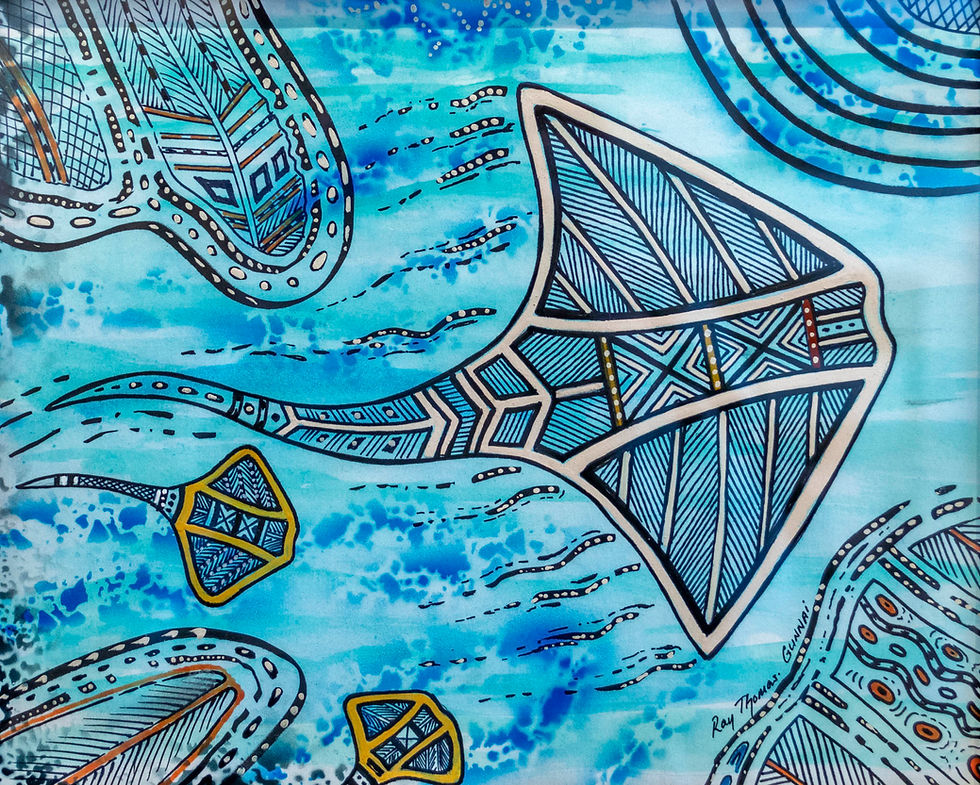
I do not presume to speak on behalf of the First Nation community, the Gunnai Kurnai, who speak through GLAWAC about this issue. I do, however, respectfully link to the work of the distinguished artist Ray Thomas who has featured on my biophiliarts site as an artist that exemplifies the regeneration of culture through Country.

Platypus, Echidna and Stingray have a colorful freedom of style depicting fauna in their habitat. Deceptively simple on first impression they reveal a level of detail that is both rich in anatomical and habitat detail that dissects flat into symbolic patterns of meaning.
For more about his work link to Gunnai Artist Ray Thomas: Regenerating Culture
East Gippsland Artist: Liz Scott ‘Surrendering to Nature’


As a Float artist-in-residence Scott captures the narrative of light and life underwater of an estuary that runs off the Gippsland Lakes with a delicate balance of life in the seasonal ebb and flow of salt and fresh water. “Once you do stop and watch and breathe and listen, it (the estuary) rises quietly up around you like an audible and visual hum. The bumping of the fish on the underside of the boat throughout the night, the gentle sway, the small window that begins to open to the daily complex bird theatre that plays out around you.”
‘…To tranquilize one’s mind is to nourish one’s spirit; To nourish the spirit is to return to Nature.’ (Taoist poem)
Scott brings a rich bag of artistic skills, tools and a deep sensibility to the fluidity of a place teeming with life and in constant flux. She has a master’s in visual arts (Monash Gippsland) and a gift for drawing. There is a mature confidence underpinning the technical experimentation and layering. Her previous diverse cultural and ecological residencies in remote Gulkistan, Iceland, and Susami, Japan, prepared her well for the intense immersion and "creative reckoning" in her own regional backyard of East Gippsland.
Scott appears fully in tune with this aesthetic and, like the ancient calligraphers, adds text that denotes place (3909 postcode) and fine details that betray the human impact on this environment. The translucent quality of the paper allows for a dramatic lighting of the underwater space. She creates a crowded composition mirroring the complexity of Nature itself.

Stockhausen looks deep into 'the eye of the Apocalyptic firestorm' to re-capture Nature's beauty and to reclaim her soul. After rigorous training as a goldsmith at the prestigious Hamburg National Drawing Academy, Germany, post-graduate studies in sculpture at Monash University and a stretch of lecturing in gold and silver-smithing at the Canberra School of Art, Stockhausen, brings a wealth of technical and analytical skills, enhanced powers of observation and the strong discipline to her work.

'Hell Fire 14' 16x16cms acrylic on canvas aluminium composite 2020
In 2021Stockhausen exhibited her series of paintings entitled “The Edge of My Vision”, some 15 plus monumental paintings that document the fires and the miraculous regeneration that has followed through Spring and early Summer. She looked deep into the eye of the firestorm, not just as a visceral threat, but “to find the beauty of the Nature” that has always been the source of her inspiration and her art since settling in East Gippsland.


Josephine Jakobi: Art is process - submerged linen in the estuary
Her indigent ancestors depended on this land for food and survival. Despite their hardship she is mindful of an "overlay of domesticity"- the gentility of homemaking, beekeeping, cooking, crocheting and stitching. The women cohabited in the intricate world of native birds and spiders, referred to as "the original weavers." This respect for the dexterity of spiders and birds extends to other species - wasps, caterpillars, beetles, grasshoppers, fungi and crustaceans; all minutiae busy in the art of survival and maintaining their own 'creature comforts' in the critical 'life and death' cycle. This sensibility stemming from her bush childhood underpins the unique art practice of Jakobi and her deep bio-ethical awareness.

Her adopted studio is an estuary ecological system, a forested area about 15 km east of the Gippsland Lakes with a total water area of about 25 sq km. It is rich in limestone, native tree and plant species including many species of Gums and Banksias that provide habitat and nectar for migratory birds and Flying Fox species of high conservation value.

"Grey-headed Flying-foxes are upside-down contortionists that can addle the human brain. I sometimes flip the images so that humans can better read them" Lisa Roberts, Media Artist and Photographer
She works from her cliff edge studio in the town of Bairnsdale overlooking the Mitchell River, the largest, wild (un-dammed) river remaining in Victoria. Roberts lives right in town but she has a 'ring-side' seat to observe the seasonal traffic on the "river highway" where "flying and swimming species breeze up and down the river." Flocks of cormorants, pelicans and occasionally dolphins follow the schools of fish. Cockatoos fly up river in the morning and down river in the late afternoon and each Autumn she begins to photograph the resident Flying-fox colony.
Roberts has set up an on-line community network entitled Pteropus poliocephalus (the scientific name for Flying-fox) where experienced field naturalists, conservationists and enthusiasts monitor the research programs, share and test information. They document action by local communities engaged in protecting vulnerable Flying-fox colonies. Roberts pursues her direct investigation through the camera lens with fresh eyes and a growing recognition of the vital interconnection between the colony adjacent to her Mitchell River frontage and the diverse ecosystems of the region.She captures the characteristics of the flying-foxes and observes their complex social behaviors.

It is one of the greatest phenomena of Nature, and it has drawn Bain to Walpa (via Lindenow) on the Mitchell River Valley upstream from the Gippsland Lakes where he is immersed in a profusion of bird-life on the river, marshes, creek beds and lakes. From his studio there are rising clouds of white Cockatoos and Ibis, fat belly-laughing Kookaburras and delicate Egrets lightly gracing the distant fields.

Recommendations
1. I refer the Planning Impact Assessment Unit to Benjamin J. Richardson, a Professor of Environmental Law at the University of Tasmania who has extensively explored the intersection of aesthetic issues and environmental policy and law. He advocates for “integrating the arts and humanities into legal frameworks and public consultations (in order) to comprehend deeper emotional and ethical connections to the environment.”
2. I urge the Victorian Department of Transport and Planning (Planning Impact Assessment Unit) to fully consider STREAM 3 ‘Landscape and Visual Amenity’ with reference to the National Heritage Criteria - Environment Protection and Biodiversity Conservation Act 1999 (EPBC Act) and recent scholarship that explores the aesthetic principles embedded in Environmental Heritage Protection Law and the importance of a “place exhibiting particular aesthetic characteristics valued by a community or a cultural group”. 'A large field of scholarship is now devoted just to environmental aesthetics. Whether it is auditory, tactile, olfactory or visual, sensory stimulation from the environment it can generate, argue these aestheticians, valuable emotional and cognitive connections to nature that are different to other forms of cultural knowledge…. It is also vital to recognise how the arts have acquired a crucial role in mediating aesthetic appreciation of nature, and how art historians have contributed to interpreting such art.” (Benjamin J. Richardson, Professor of Environmental Law: The Art of Environmental Law Governing with Aesthetics, Paperback 2017).
3.I urge the assessment panel to respectfully acknowledge and consult with East Gippsland’s outstanding creative practitioners (artists, designers and artisans and the keepers of East Gippsland Cultural Heritage) as a sector that constitutes a ‘cultural group’ with legitimate and specialist knowledge of the unique aesthetic beauty and cultural complexity/fragility of this environment and what is at stake in this decision-making process.
4. That this 'cultural group' (including artists, artisans and the keepers of local cultural heritage) meet with Gippsland Critical Minerals company and the Planning Impact Assessment Unit, Department of Environment, Planning and Resources, with a view to clarifying what 'social license' means to GCM and the Department of Environment, Planning and Resources and how it accounts for preservation of the aesthetic beauty and cultural values of this region. What guarantees do they have that the cultural heritage and aesthetic beauty of East Gippsland that underpins our regional identity and reputation, will NOT be severely degenerated or have irreversible negative social,environmental or aesthetic impact in the short and long-term.
East Gippsland Chefs, Winemakers, Brewers, Dairy Producers, Restaurateurs create the Clean Green brand and strengthen the cultural identity of the East Gippsland region.


Comments